

 Aboriginal and or Torres Strait Islander Resource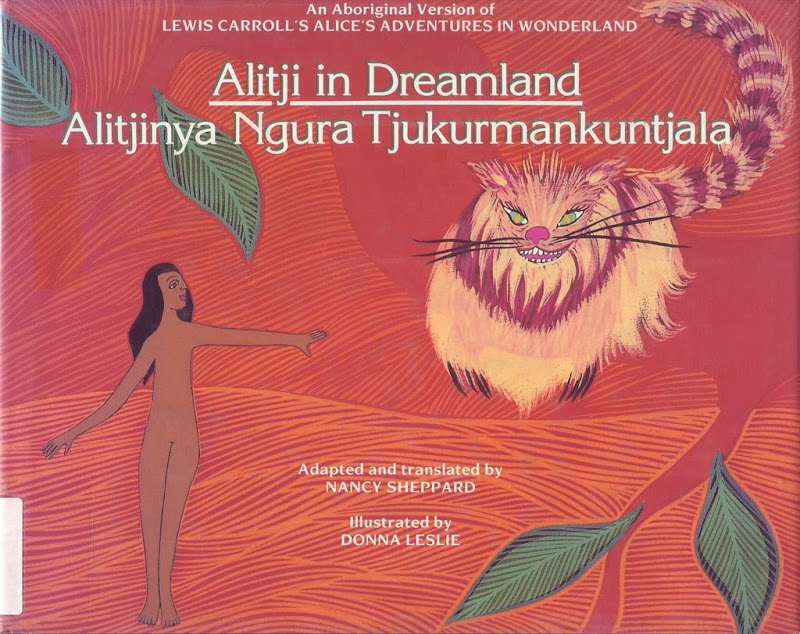
Title
Alitji in Dreamland / Alitjinya ngura tjukurmankuntjala : an Aboriginal version of Lewis Carroll’s Alice’s adventures in Wonderland
Author
Nancy Shepppard
Illustrators
Donna Leslie
Publisher, Date
Simon & Schuster, 1992
Audience
Primary, Secondary, Upper Primary
ISBN
0731801989
Language
Pitjantjatjara

Add to Favourites
-
Subjects
- Anangu people
- Animals
- Bilingual books
- Bush tucker
- Courage
- Desert
- Desert animals
- Dreams
- Echidnas
- Emus
- Fantasy
- Feral animals
- Food
- Glossaries and vocabularies
- Humour
- Imagination
- Individuality
- Kangaroos
- Pitjantjatjara people (C6) (NT SG52-11)
- Self-esteem
- Stockmen
- Wild foods
- Witchetty grubs
-
Annotation
Nancy Sheppard (b.1934) was the teacher at Ernabella, Central Australia, from 1955 to 1964 where she was immersed in the language and culture of the Pitjantjara people of the Aṉangu Pitjantjara Yankunytjatjara (APY) Lands. From the 1950s onwards many Aṉangu were forced to leave their traditional lands, due to the British nuclear tests at Maralinga. Despite dislocation and outside influences Pitjantjara people have retained their language and much of their culture.
Sheppard’s first publication of ‘Pitjantjara Alice in Wonderland, Alitji in Dreamland / Alitjinya Ngura Tjukurmankuntjala : an Aboriginal version of Lewis’s Carroll’s Alice’s adventures in Wonderland’ in 1975 was the 44th translation of Lewis Carroll’s story into another language, and the first English language edition produced in Australia. This 1992 edition is illustrated by Donna Leslie, (b.1963) now a respected art historian and art practitioner. Leslie’s illustrations elevate the story to a fascinating visual experience. Sheppard’s adaptation is very accessible to a wide contemporary audience, whilst Leslie’s combination of Western and Aboriginal art traditions reflects the renaissance of First Nations art in the late twentieth century that highlighted issues of identity and cross-cultural relationships. Each page has text in Pitjantjara and English. Leslie’s red-earth dreamland is aglow with the lush vivid colours of the desert—purple, orange and red. Alitji floats and bounces, shrinks and expands to dominate the page. Alitji follows a white Kangaroo, with a dilly bag and digging stick, down a hole in a creek bank. She is offered advice from a Witchety grub. The pepper that makes the baby sneeze is from the itunypa root, and it changes into a bandicoot. The bullying Queen becomes The Witch Spirit, who engages an echidna to do her bidding at the Witch Spirit’s Game, the ‘croquet party’.
A Glossary is provided and ‘Notes to Alitji’ by writer and editor, Barbara Ker Wilson. The Pitjantjara community with whom Sheppard lived were delighted with her story. Whilst retelling a classic English children’s story to Indigenous children in their native language, it introduces Pitjantjara to a wider audience. ‘Alitji in Dreamland/Alitjinya Ngura Tjukurtjaranka’ remains an outstanding contribution to the field of bilingual First Nations/English books for children.
-
Teaching Resources
- Information on APY Lands https://en.wikipedia.org/wiki/A%E1%B9%89angu_Pitjantjatjara_Yankunytjatjara
- Australian Government Department of Education. First Nations Languages Education Program https://www.education.gov.au/schooling/first-nations-languages
- South Australia Landscape ‘Eastern Anaangu Pitjantjatjara Yankunytjatjara and Tallaringa landscape’ About these lands, landscape, flora and fauna https://www.landscape.sa.gov.au/aw/visiting/landscapes/eastern-apy-and-tallaringa
- Kids Book Explorer. Natalie Bragaru reviews ‘Alitji in Dreamland/Alitjinya Ngura Tjukurtjaranka’ https://www.kidsbookexplorer.com/alitji-in-dreamland-alitjinya-ngura-tjukurmankuntjala-nancy-sheppard-donna-leslie/
- The Sydney Morning Herald, 26 September 2015. Jane Sullivan reviews State Library of Victoria exhibition ‘Alice in Wonderland through the Ages: literature’s most curious girl turns 150.’ https://www.smh.com.au/entertainment/alice-in-wonderland-through-the-ages-literatures-most-curious-girl-turns-150-20150925-gjuoes.html