

 Aboriginal and or Torres Strait Islander Resource
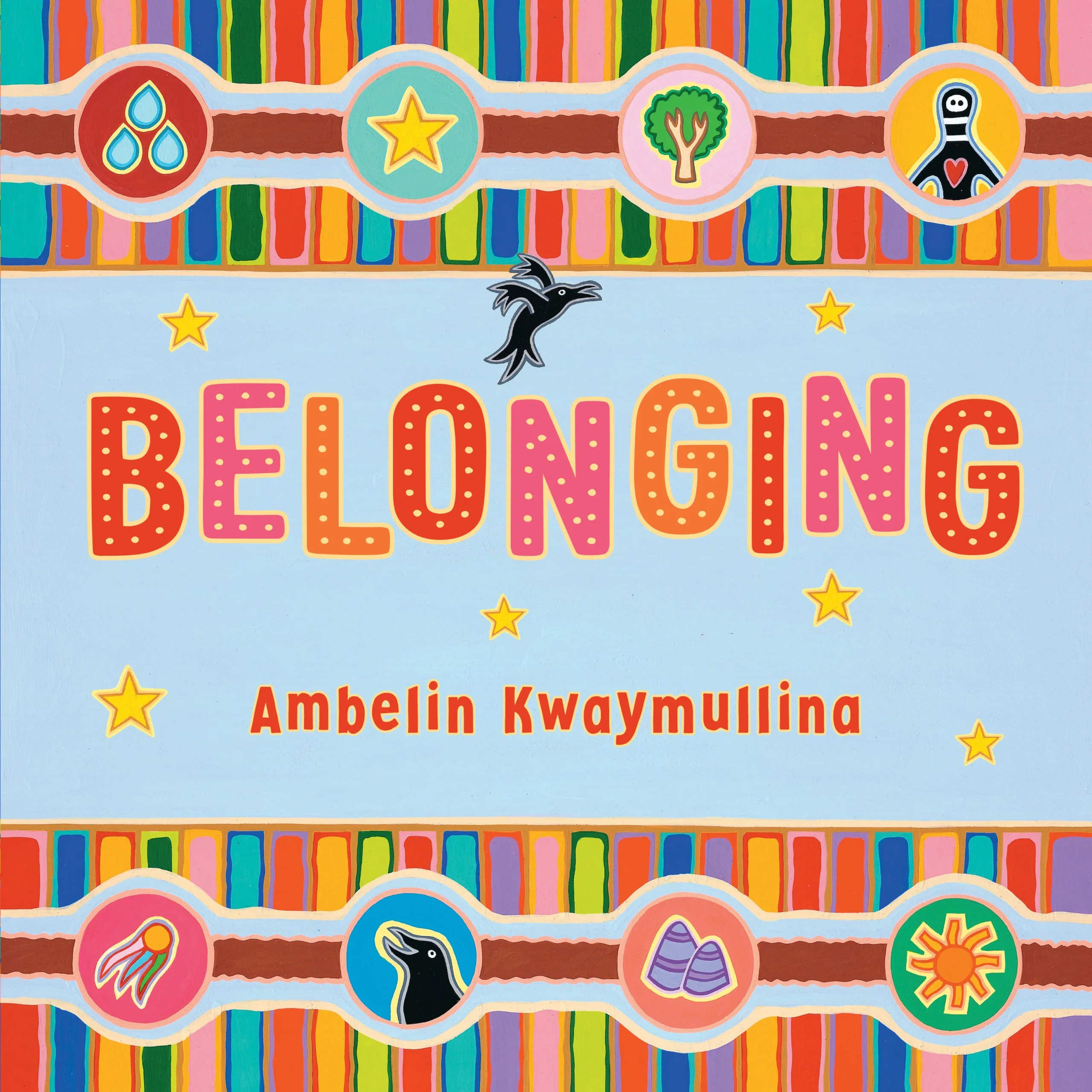
Title
Belonging
Author
Ambelin Kwaymullina
Illustrators
Ambelin Kwaymullina
Publisher, Date
Magabala Books, 2026
Audience
5-8yrs, Lower Primary, Primary, Upper Primary
ISBN
9781922864819

Add to Favourites
-
Subjects
- Animals
- Art motifs
- Art techniques
- Country
- Cultural protocols
- Endpapers
- Environment
- Environmental protection
- First contact with Europeans
- History
- Indigenous knowledge
- Land rights
- Plants
- Relationship to place
- Settlement and contacts
- Social life and customs
- Survival
- Symbols
- Trees
-
Annotation
The last sentence of ‘Belonging’ delivers this book’s underlying message: ‘When we all come together to nurture connections we make pathways that lead to new stories everywhere’. Introductory pages explore the First Nations People’s connection to and care of Country. Kwaymullina states that when the ‘colonisers’ arrived, they referred to the land as ‘terra nullis’ which was interpreted as ‘you could own a place by claiming that the people who live there are less than you’. This interpretation was used to dispossess the First Nations peoples of their land. ‘Belonging’ argues that First Nations Peoples continued to belong to their Countries.
There is an arresting and meaningful visual message in a double page illustration midway through ‘Belonging’. The artwork may be interpreted as Aboriginal peoples surrounded by symbols of Country and proudly displaying statements showing the strength, pride and longevity of their connection to Country.
Endpapers offer additional meaning. Waving horizontal strips of bold colours steak across the double page. These grab attention for the important statement that ‘Belonging’ makes. There is a direct, strongly worded statement about Australian Aboriginal Peoples’ history and their ongoing connection to their country. ‘Belonging’ then is about bringing together the Aboriginal People, who first occupied Australia, and those who arrived later. This joint goal weaves throughout: to work in harmony and to jointly look after this land.
Direct statements tell the reader that the First Nations Peoples were dispossessed of their land by the newcomers who claimed the concept of ‘terra nullius’. First Nations People continued to belong to and look after their Country. ‘Belonging’ aims to create support for a future that brings First Nations Peoples and those arriving later to look after the land together. In a concluding statement, Kwaymullina discusses the concept of ‘terra nullius’ briefly highlighting its historical background. The ‘terra nullius’ concept is a complex one which requires additional background material to understand ideas presented in ‘Belonging’. For this reason, ‘Belonging’ is suitable for a wide age range.
Ambelin Kwaymullina is from the Palyku people of the eastern Pilbara region in Westen Australia. She is a writer, illustrator and academic. Her works for young people include young adult novels, picture books and nonfiction.
-
Teaching Resources
- Readings June 2026 review by Tamuz Ellazam of ‘Belonging’ by Ambelin Kwaymullina https://www.readings.com.au/reviews/belonging-by-ambelin-kwaymullina
- ReadPlus 10 Aug 2026 review by Kathryn Beilby of ‘Belonging’ by Ambelin Kwaymullina https://www.readplus.com.au/reviews/belonging
- Ambelin Kwaymullina’s website https://akauthor.com.au/#!/
- Wikipedia entry for Ambelin Kwaymullina https://en.wikipedia.org/wiki/Ambelin_Kwaymullina
- Paperbark Joy in Books 30 June 2020 discussion between Joy Lawn and Ambelin Kwaymullina author of the ‘Living on Stolen Land’ as well as Kwaymullina’s thoughts about her writing https://paperbarkwords.blog/2020/06/30/living-on-stolen-land-by-ambelin-kwaymullina/