

 Aboriginal and or Torres Strait Islander Resource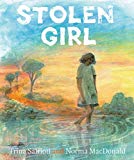
Title
Stolen Girl
Author
Trina Saffioti
Illustrators
Norma MacDonald
Publisher, Date
Magabala Books, 2011
Audience
Lower Primary, Primary, Secondary
ISBN
9781921248252
Language
English

Add to Favourites
-
Subjects
- Australian Government policy
- Children, Aboriginal Australian
- Culture
- Domestic work
- Emotions
- Historical Fiction
- Loneliness
- Missions
- Mothers
- Parent and child
- Stolen generations
- Visual literacy
-
Annotation
The ‘Stolen Girl’ is author Trina Saffioti’s fictionalised account of what may have happened to her maternal grandmother who was taken from her family at a young age.
A young unnamed girl has a special relationship with her mother, sharing meals and learning how to hunt and gather food. At night she listens to the Elders tell stories from the old days. One day when they are in town the young girl is grabbed by a uniformed man and dragged into a car. She screamed for her mother, but it was too late, and she is driven away to a ‘new home’ that she is told she would like. At this ‘new home’ she is given an old dress to wear and quickly learns from the other girls that she ‘ain’t’ going home. Her days are filled with schoolwork, cooking and cleaning, and she is exhausted. She dreams of going home but each day she wakes to the loud ringing of the bell, still in the dormitory. She longs to go home sending songs and thoughts to her mother far away and she hears ‘Time to come home now’.
She begins to work on how to leave and how far she can get before she’s too tired or before her absence is noticed. And when the time comes, she slips out before the bell rings, finds the keys unlock the door and steps out for home.
This is a highly emotive story. She dreams and longs constantly for her former life and the planning to an eventual leaving is also part of her dreams. The unresolved ending is heart-breaking however it does allow hope and reassurance to young readers. You wish desperately for an escape from the misery and deprivation of the home buts realise real escape is a pipedream. Her unnamed status makes her symbolic of every Stolen Generations child.The artwork features warmer tones in the illustrations of the girl’s family life reflecting the warmth and happiness she knew and felt. The unhappiness of the home is captured both by cooler colours and the faces of the girls.
The Stolen Generations is seen as a shameful part of Australia’s colonial history. It is believed that over 100,000 children were forcibly removed from Aboriginal and Torres Strait Islander families under the Australian Government’s ‘Assimilation’ policy that children who were not ‘full blood’ should be integrated into the wider white society. These children were placed in institutions all over Australia away from Country and family, denied their Indigenous names, their language and their Culture. Many never saw their family again.
Trina Saffioti is descended from the Gugu Yulangi people of Far North Queensland. Norma MacDonald is a Yamitji woman from the Gascoyne region and the Nyungar people of the South West of Western Australia.
-
Teaching Resources
- Magabala Books. Teacher Notes by Christine Wheeler for ‘Stolen Girl’ by Trina Saffioti and Norma MacDonald https://cdn.shopify.com/s/files/1/0092/5043/9268/files/Stolen_Girl_Teacher_Notes.pdf?2382
- CopyrightAgency Reading Australia 2017. Unit writer by Carmel Turner for ‘Stolen Girl’ by Trina Saffioti and Norma MacDonald https://readingaustralia.com.au/lesson/stolen-girl/
- Kids’ Book Review 23 March 2011. Tania McCartney reviews ‘Stolen Girl’ by Trina Saffioti and Norma Mac Donald http://www.kids-bookreview.com/2011/03/review-stolen-girl.html
- Where the Books Are 13 February 2017. Kim Fulcher writes a commentary: ‘A tender but unflinching story of the Stolen Generation’ about ‘Stolen Girl’ by Trina Saffioti and Norma MacDonald https://www.wherethebooksare.com/blog-1/stolen-girl
- National Museum of Australia 22 June 2020 Michael O’Loughlin writes ‘The Stolen Generation’ https://australian.museum/learn/first-nations/stolen-generation/
- Australian Government Australian Human Rights Commission. ‘Historical Context – The Stolen Generations’ includes timeline of events https://bth.humanrights.gov.au/significance/historical-context-the-stolen-generations