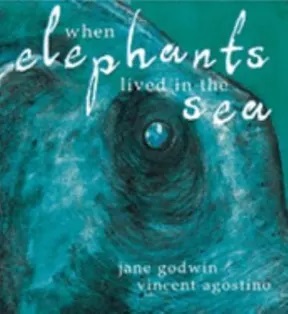
An example of a creative non-fiction picture book where full colour illustrations and text combine to trace the evolution of the elephant from ancient marine creature using its trunk as a snorkel to the land mammal we know today.
Based on fact, it explores how and why elephants learned to swim and explains that they were once estuary and ocean-dwelling creatures related to the dugong and whale. Despite abandoning the aquatic environment around fifteen million years ago they are still strong swimmers and have a particular affinity for water. Scientists believe that the Order Proboscidea (the scientific name for the elephant family) and the Order Sirenia (dugongs, manatees and sea cows) may have shared a common aquatic ancestor.
The text is sparse, lyrical and poetic enhanced by double spreads which are filled with rich bold aqua and earth tones. Different perspectives and points of view are presented with the text occasionally being shaped and curved around the images.
Whilst the tale sounds implausible it is based on scientific fact. In 1999 the University of Melbourne conducted a study of elephants and their ancestors. Details of the study and other information corning elephants and their affinity with water is included at the end of the book.


 Picture Books for Older Readers