
Exploring NCACL’s Databases
Sarah Paterson
I have had the privilege of completing my Masters of Teacher Librarianship placement at the National Centre for Australian Children’s Literature (NCACL). I have spent the past 4 weeks working alongside dedicated and passionate information professionals, each who took the time to highlight their role in the collection, providing me an inside look at the vast offerings that NCACL holds for the Australian community.
While I had the opportunity to complete many tasks at NCACL, including author files, annotated bibliographies, and art frameworks for original artworks, one of my favourite tasks was writing annotations on contemporary children’s literature for the different databases that they produce. NCACL has 4 main databases available for free to the public, each with a different focus, to highlight books that can be used to better select literature for schools and homes across Australia.
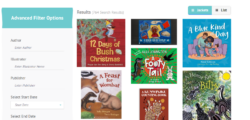
The first is the ‘Aboriginal and Torres Strait Islander’ Database. This has close to 800 books that celebrate First Nations cultures, histories and themes, and offers detailed annotations about the text, teaching resources, reviews, and other supporting materials. This database is extremely useful to use as a teacher or homeschool parent, as it allows you to search by subject areas, providing you with a list of mentor texts to embed authentic First Nations resources into different curriculum areas. This not only aids in providing authentic representation in our schools, it also supports the teaching of the Cross Curriculum priority ‘Aboriginal and Torres Strait Islander Histories and Cultures’, a requirement under the Australian Curriculum V9.
The second database is the ‘Picture Books for Older Readers’ resource. This database carefully curates quality children’s picture books that can be used in classrooms from Year 4 upwards. Through this database, quality books are selected that support the teaching of different curriculum subjects or themes through the literature. The database has detailed annotations, highlighting the uniqueness of the books, the key themes, and how they might be used in a school or home school setting. Curriculum links, teaching resources and further information on the books are also included as hyperlinks, to support teachers and parents access further information on all texts in the database.
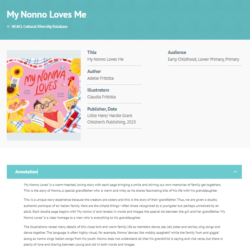
The ‘Cultural Diversity’ database specialises in children’s literature that has cultural themes authentically represented throughout the text. This database is for children of all ages and includes detailed subject headings to aid selection of books for specific learning purposes. Again, the annotations are detailed and highlight how each text could be adapted into classroom lessons. This ensures that the books we use in schools and homes are inclusive and diverse, offering all students an opportunity to see themselves represented, while building perspectives into the lives of others in our community.
Finally, the ‘Verse Novel’ resource is one of the newest offerings by NCACL. This database, split into younger and older readers, provides detailed information on verse novels for children. Through this database, a different type of literary technique is explored for narratives, with the poetic style lending itself to be easily accessible for most children. Through this database, teachers can select texts to expose students to a growing genre that uses verse and poetic devices to convey stories that are both moving and highly original.
These free resources aim to advocate for the inclusion of diverse contemporary children’s literature to be read in homes and schools across Australia, ensuring that children have opportunities to see many different lives and perspectives, including their own. The databases also aim to build inclusive and diverse environments through literature. Dr Adam discusses the importance of diverse literature for children in building a strong sense of identify and empathy into others’ lives, explaining “it is vital that librarians, educators and caregivers can all identify and access quality authentic diverse books to share and put in the hands of children” (Adam, 2023, p.1). The NCACL databases are an excellent tool to do this, and you can access them freely here.
References:
Adam, H. (2023). Is your library the window and mirror all children need?. Connections, 125, 1-3. https://www.scisdata.com/connections/issue-125/is-your-library-the-window-and-mirror-all-children-need
Sarah Paterson is a Canberra primary school teacher with over ten years of experience, now stepping into school leadership role. Driven by a deep passion for literacy and literature, she loves helping students discover the magic of reading and is in her final semester of her Master of Education (Teacher Librarianship) at Charles Sturt University.
Posted by: NCACL | Published: 23 Oct 2026
0 Comments
There are currently no comments, be the first to leave one